International Editions
Story Teller brought magic and pleasure to children all over the world. The UK edition was also released in Ireland and Malaysia while it was rebranded as Story Time in Australia, New Zealand and South Africa. Story Teller was also released in Spanish, German, French, Greek, Afrikaans, Dutch and, most recently, Russian. This section is being developed with members of the Story Teller Facebook group as a tribute to all the different editions of Story Teller. If you would like to help develop this section, or if you spot any errors, please contact us.
Storie-Man (South Africa)
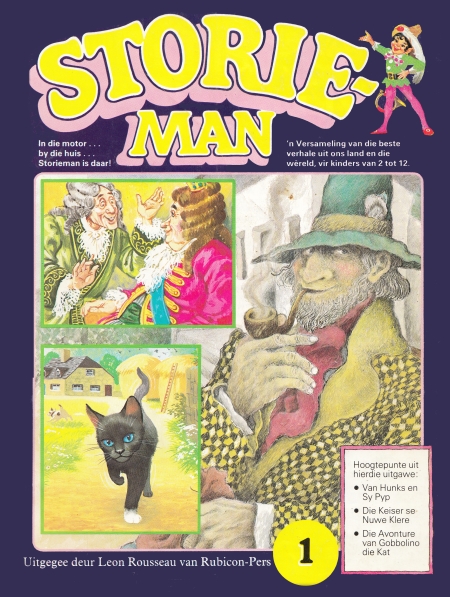
Storieman, the Afrikaans version of Story Teller, is arguably the most successful foreign edition. The first ever issue sold 35,000 copies when first published and the whole series has been reprinted several times.
Storieman was first published in 1984 by Leon Rousseau of Rubicon-Press as a 30-part series. It was launched in June of that year at a children’s party held in Leinster Hall, Leon Rousseau’s 19th century home in Weltevreden Street, Tuine, Cape Town. Leinster Hall hosts the Cape Town Club today as well as the Leinster Hall Restaurant.
Everyone will of course remember the “Ping!” that indicated the need to turn the page but South African fans will remember even more the leprechaun. The Afrikaans edition made more use of the happy leprechaun who appeared in every cover, dressed in red pants, green jacket and feathered hat. In the UK edition, the leprechaun was less prominent, appearing only in the contents pages of every issue and on the back page of four of the early issues.
The South African children of the 80s fondly remember Storieman as their door to the wonderful world of stories and was a magical part of their childhood. Writer Maya Fowler even admits that it was Storieman which inspired her to start writing.
In addition to the stories contained in the original UK edition, Storieman featured South African stories such as Uan Hunks and His Pipe, Frits Deelman and the heroic deeds of Wolraad Woltemade and Racheltjie de Beer. The stories were read by celebrities like Sandra Prinsloo, Cobus Rossouw and Verna Vels.
On 12 October 2008, the series was reissued with CDs but only 1000 copies were published, which makes the series a collector item. To celebrate the launch of the limited release, the original guests from the 1984 party, still in Cape Town or in the vicinity, were invited to a small sparkling breakfast in Leinster Hal.
In 2012, Human & Rousseau in collaboration with Leon Rousseau, released a series of six omnibuses compiling the most popular stories from the original series. To decide which stories to include, the publishers sought the opinions of fans.
Story Time (Australia/NZ)
Story Teller was published in Australia and New Zealand as Story Time. It had a similar logo to the UK Story Teller with the same design elements and fonts.
In Australia, Story Time only ran for one series, so the final issue (part 26) did not contain the double-length (90-minute) tape or the special preview magazine for the next series. This was the sole difference between its UK counterpart; the cassettes and artwork were otherwise identical.
Fans in New Zealand, however, were treated to the second series, as can be seen in this photo.
Сказочник (Russia)
Сказочник (Story Teller in Russian) is the most recent version of Story Teller. It was published with CDs from 2006 to 2009 by GE Fabbri Ltd. The series was published in 40 parts, with the involvement of Eden Phillips who was in the editorial board of the original UK edition.
Readers included Kirill Kashlikov, Andrei Saminin, Rimma Zyubina, Lyudmila Ardelyan, Eldar Kurtseitov, Dmitry Tuboltsev, Lesa Samaeva and Mikhail Kukukuk. Each issue came with four or five stories with the CD running time of just under 30 minutes. In comparison, the UK edition had six or seven stories per issue, with the cassette running for 45-50 minutes.

I Racconta Storie/C’era Una Volta (Italy)
The Italian version of Story Teller was released as a two-series collection over two years like the UK edition between 1983 and 1984. Unlike the UK edition, however, the two series had different titles. The first series was called I Racconta Storie (I Tell Stories) while the second was called C’era Una Volta (Once Upon a Time).
It appears that the special preview issue for Story Teller 2 (that was released in the UK as a freebie in Part 26 of Story Teller 1) was not published in Italy which means the final issue of I Racconta Storie came with the regular 45-minute cassette. All three Christmas specials, however, were given an Italian release even though the third was heavily based on Little Story Teller, a series not published in Italy.
The story listing in the Italian edition is very similar to the UK edition. In I Racconta Storie, the poems from the UK edition were retained, though it goes without saying they were translated. However, in C’era Una Volta the poems were replaced with activity pages.
The magazine covers did not follow the colour scheme of the UK edition and in many issues, different illustrations were placed on the cover.
There are a few unusual changes in the artwork. Here are a couple:
- Anna Dzierzek illustrated The Emperor’s New Clothes in both the Italian and UK editions, but in the Italian edition, the emperor has a moustache and a beard and the men behind him wear different wigs. Apart from these differences, the rest of the illustrations are identical, but one wonders why they made those changes in the first place.
- The poem Oliphaunt, a poem from The Lord of the Rings about elephant-like animals with trunks that look like snakes, was re-interpreted rather than translated for the Italian edition. The poem was rewritten to be about a normal elephant and the artwork was changed to reflect this.
I Racconta Storie was rereleased with CDs in the late 1990s but with completely different artwork, possibly because of rights issues. The new artwork bore no resemblance to the original, making the new version unpopular with the fans.
Cuenta Cuentos (Spain)
Following the huge success of Story Teller in UK, the Spanish publisher Salvat acquired the rights for the Spanish edition, Cuenta Cuentos. The first issue came out in March 1983.
The collection had the same format as the British edition but, unfortunately, it was incomplete because only 39 parts were published. The final 13 parts and the Christmas specials were not released, depriving Spanish children of classics like Peter Pan and Alice’s Adventures in Wonderland, among many others. Part 39 was published in 1984.
The collection was re-edited in 1986 with a different format, reducing the number of pages in each magazine by half and shortening the duration of the cassettes. Sixty-five parts of this new format were published, although the stories were exactly the same as in the previous version. The covers were different, however.
Personally, I think Cuenta Cuentos was quite successful in Spain, and it will always be a mystery to me as to why the collection was incomplete. Perhaps the editors expected even better sales? Unfortunately I have not found any information on the internet.
UK vs Spanish Edition
The main difference between the two editions is, as I have said, that the Spanish version only had 39 issues instead of 52.
Apart from this, Spain’s Cuenta Cuentos is almost identical to the British Story Teller, but I have found three important differences:
The magnificent short poems of the UK edition were replaced in Spain by beautiful songs performed by Rosa León, a singer famous at the time and who will always be remembered for these children’s songs.
In magazine 27 (which is the equivalent of Story Teller 2 Part 1) three good stories, The Creatures with Beautiful Eyes, The Circus Animals’ Strike and Yushkin the Watchmaker, were not published. These were replaced by Snow White and Aladdin and his Magic Lamp which in the UK were published in Christmas Story Teller 1. I do not know why, although I guess that since the Christmas specials were not published in Spain, the editors wanted to include these two very famous stories in somewhere in the series. Unfortunately, because of this we lost the three wonderful stories mentioned above.
by Juan Manuel Cobos Gago


Erzähl mir was (Germany)
Erzähl mir was loosely translates as “Tell me something” and the magazine was subtitled “The most beautiful children’s stories in the world to collect”. Like its UK counterpart, Erzähl mir was came out fortnightly and fifty-two issues plus one Christmas special were published. The series was continuously numbered from one to fifty-two and was not split into two series like the UK and Italian editions. The story listing was very similar to the UK edition, though the covers often had different illustrations and did not follow the same colour scheme. Readers included Hans Paetsch, Maria Schell und Thomas Fritsch.
A distinctive design element of the German edition was the balloon in the masthead next to the logo with the issue number superimposed on it. Erzähl mir was carried the colouring pages that were so popular in the UK plus activity pages at the back of each issue.
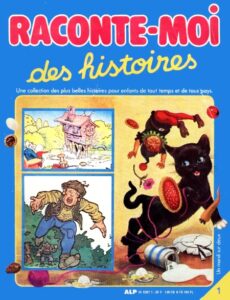
Raconte-moi des histoires (France)
Raconte-moi des histoires (Tell Me Stories) was published in France by Marshall Cavendish between 1982 and 1985. The series consisted of 26 issues and three Christmas specials which amounted to 728 pages of stories plus 130 colouring pages.
There were almost 200 stories included. Readers included Catherine Laborde (Gobbolino), Jackques Muller (Timbertwig), François Chaumette (Gulliver’s Travels), and Michl Elias (Pinnochio).
Raconte-moi des histoires followed the first series of the UK edition closely, with only a few of the stories replaced in the French edition. All three Christmas specials were published, even though Story Teller 2 and Little Story Teller, on which the second and third specials were based, were not published in France.

Άμπρα Κατάμπρα (Greece)
The Original Edition
The Greek edition of Story Teller is called Άμπρα Κατάμπρα (Abracadabra). Paramythas would have been a more accurate translation of “story teller”. Unfortunately, the word paramythas was already in use as the title of a popular TV serial. Only 26 issues were published in Greece, which means we never got Story Teller 2.
Greek celebrities who narrated the stories included Aliki Vougiouklaki, Kostas Rigopoulos, Katia Dandoulaki, Alekos Alexandrakis, Kakia Analyti, Kostas Karras, Nikitas Tsakiroglou, Zanos Dania, Sotiris Moustakas , Xenia Kalogeropoulou, Chrysoula Diavati and Martha Vourtsi. Aliki Vougiouklaki, the national star of Greece, narrated Gobbolino. The supervisiion and the direction of the cassettes were commissioned to another well-known actor, Stefanos Linaios.
The Re-issued Collection
Much to the delight of the Greek fans, in 2008, the series was re-released as hardback books with CDs instead of cassettes.
The UK vs the Greek edition
Άμπρα Κατάμπρα was very similar to the UK edition, with an almost identical story listing and the same artwork, as shown in this picture:
There were minor changes. In parts 7, 23, 25 and 26 some stories from the UK original were replaced, including Little Spook of Spook Hall, Mr Miacca and Captain Bones. The reason I can think of is that those stories might were been considered unsuitable for children or that Greek children may not be familiar with their themes (such as in The Faery Flag).
by Γεράσιμος Χρυσοβιτσάνος
Luister Sprookjes en Vertellingen (Netherlands)
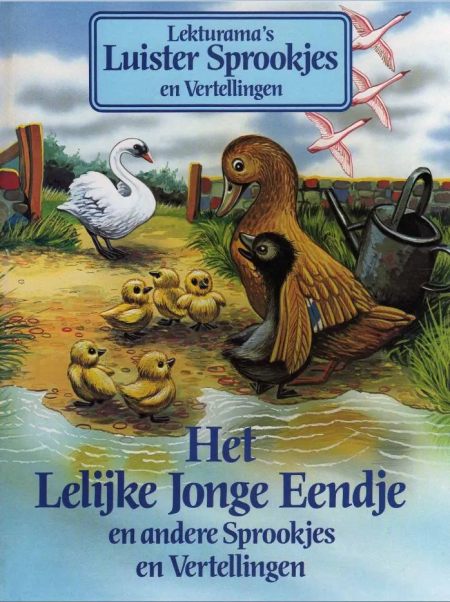
The Dutch edition of Story Teller was published by Lekturama and comprised 39 hardback books and each one had roughly double the number of pages as the UK edition. The series was not sold in shops but rather by mail order. To entice collectors, the first book was offered at a low introductory price.
Appearance-wise, Luister Sprookjes en Vertellingen is probably the most distinctive of all Story Teller editions because its logo is a simple text-based design and not the colourful and big logos favoured by other editions of Story Teller. The covers also only carried one illustration and not three like the UK edition.
In many cases, stories which were treated as serials in the UK edition, such as Pinnochio and Gobbolino, and were therefore spread over several issues, were published in a single issue. The Dutch edition also carried several stories, mainly classic fairy tales illustrated by Francis Phillips, that were not included in other editions.
The stories were told by Frans van Dusschoten and Trudy Libosan. One element of the UK edition that the Dutch version retained, however, was the colouring pages.
YouTube
- Individual stories are reproduced in video form by the Dixidito Film Producties YouTube Channel.
- There is also a playlist on YouTube that reproduces each book as one video.
With thanks to the Lekturama’s Luister Sprookjes en Vertellingen Facebook page for providing some of the information.